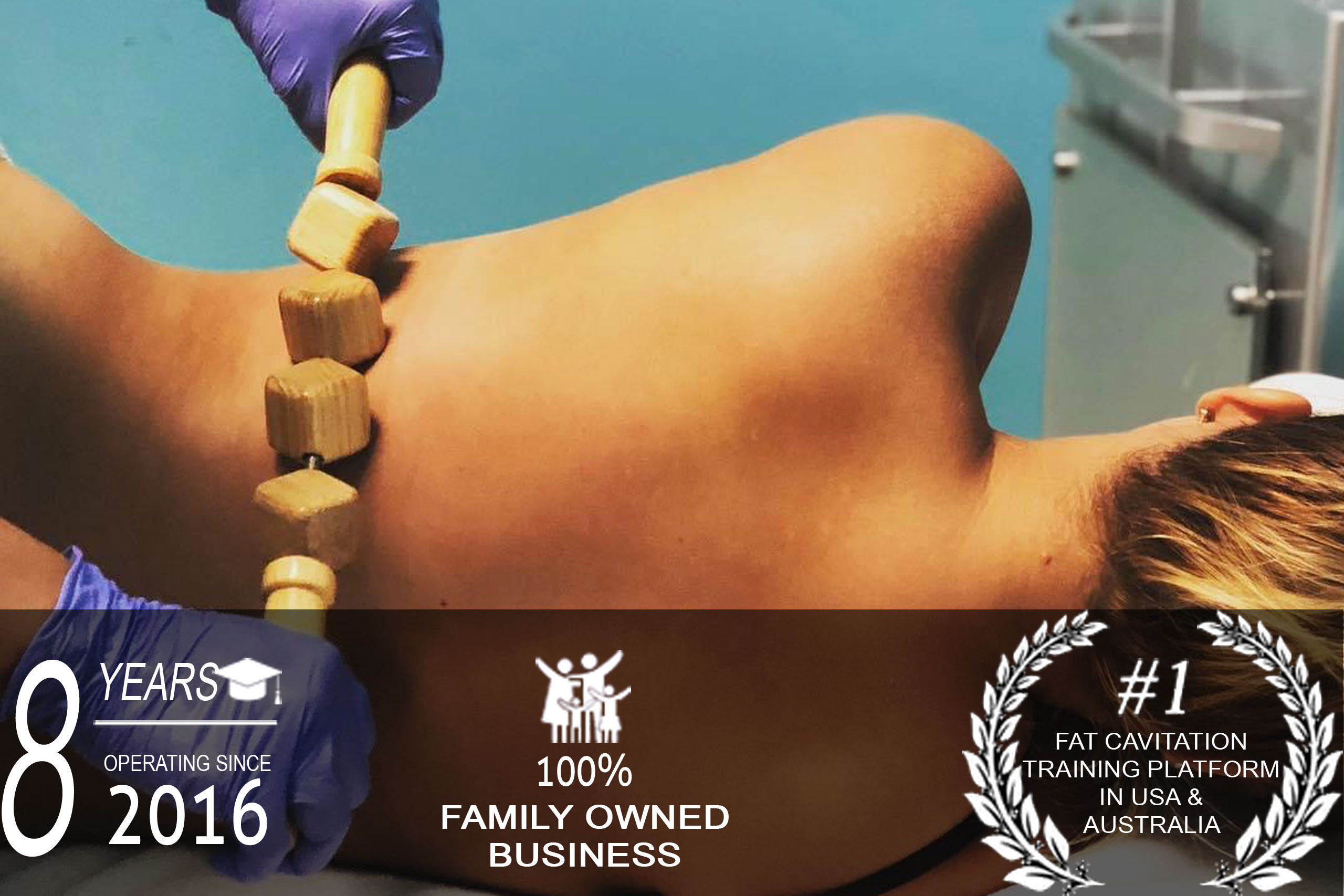
Colombian Wood Therapy, also known as Maderotherapy, is one of the most in-demand non-invasive body contouring treatments. Hands-on, effective, and requiring no machine investment beyond a set of wooden tools, it is an accessible and lucrative addition to any body contouring practice.
What Is Wood Therapy?
Wood therapy is a manual body contouring technique that uses handcrafted wooden tools to manipulate, tone, and sculpt the body. The technique applies targeted pressure to stimulate:
- Lymphatic drainage
- Blood circulation
- Breakdown of fibrotic tissue and cellulite
- Improved body contour appearance
- Reduced fluid retention
The treatment is typically applied to the abdomen, flanks, thighs, buttocks, and arms.
What Does Wood Therapy Certification Cover?
A comprehensive wood therapy certification course covers:
- The history and origins of Colombian wood therapy and Maderotherapy
- Anatomy and physiology relevant to body contouring
- The therapeutic effects of wood therapy on tissue
- Types of wooden tools and their specific applications
- Body mapping and treatment planning
- Contraindications and client screening
- Full body treatment protocols
- Aftercare and client education
Who Needs Wood Therapy Certification?
Wood therapy certification is important for:
- Insurance purposes — insurers require evidence of training in each treatment you offer
- Client safety — contraindication knowledge is essential to avoid adverse outcomes
- Professional credibility — clients and potential employers want to know you are trained
- Business confidence — understanding protocols allows you to deliver consistent, quality results
Body Contouring Courses Wood Therapy Certification
Body Contouring Courses offers the Colombian Wood Therapy Certification as a standalone course ($98.50 USD) or as part of the complete 10-in-1 Body Contouring Certification bundle ($198.50 USD).
The course is delivered 100% online, self-paced, with lifetime access. Body Contouring Courses is a CPD accredited provider.
Upon completion, students receive a certificate of completion from Body Contouring Courses.
Is Wood Therapy a Good Business Addition?
Yes — wood therapy has several advantages as a business treatment:
- No machine required — your only equipment investment is a set of wooden tools
- High demand — clients are actively searching for wood therapy practitioners
- Complementary — pairs well with cavitation, radiofrequency, and EMS
- Mobile-friendly — the treatment can be delivered at a client's home with minimal equipment
Summary
Wood therapy certification provides the training, credentials, and confidence to safely and professionally perform Colombian wood therapy (Maderotherapy) treatments. Completing a recognised certification from a CPD accredited provider is essential for insurance purposes and professional practice.
A practical next step for this topic
For wood therapy certification, compare how a course teaches tool selection, grip, pressure, cleaning, consultation and client communication. Ask what completion demonstrates and whether additional practice is appropriate for your background. A certificate should not be described as a massage licence or permission to treat a medical condition unless the relevant authority actually grants that status.
Compare the learning process, not just the certificate
Ask for the syllabus before buying a course. Identify which parts explain underlying principles, which demonstrate practical tasks and which address consultation, contraindications, hygiene, record keeping and aftercare. Check whether written material accompanies the videos and whether you can revisit the content. A short demonstration may be useful, but it should not be mistaken for a complete qualification or evidence of competence with every device marketed under the same treatment name.
Clarify how completion is recorded and what, if any, assessment is involved. Ask questions about unfamiliar terminology rather than treating the number of modules as a quality measure. The advertised study duration is not a promise that every learner becomes ready for independent practice within that time. Someone new to the field may also need foundational education, supervised experience, professional registration or device-specific instruction, depending on the intended work.
Build a learning log as you study. For each topic, note what you understand, what needs clarification and which information must come from the manufacturer, regulator or insurer. This turns a course comparison into a practical preparation plan. Keep a copy of the curriculum and certificate wording so you can describe the training accurately to an employer or insurer. Do not advertise a government licence, manufacturer endorsement or specialist clinical qualification that the course does not provide.
Plan practice without treating a video as permission
Separate learning about a service from offering it to the public. Before practical work, confirm that the setting, supervision, device instructions and participant arrangements meet the requirements for your role. A willing friend is not a substitute for a suitable learning environment, proper screening or insurance. Do not improvise a protocol from notes gathered across unrelated machines or assume that reducing a setting makes an unauthorised procedure acceptable.
Use a staged preparation checklist: understand the terminology; explain the consultation process; identify the relevant equipment documentation; recognise reasons to defer; and know who should be contacted when a question exceeds your competence. Those are learning objectives, not a claim that passing a checklist guarantees a safe outcome. Where an employer, professional organisation or device supplier requires a particular assessment, arrange it before taking responsibility for clients.
Review your public description of the service at the same time. Explain what it involves in plain language, avoid treatment or income guarantees and distinguish cosmetic goals from healthcare claims. A certificate of completion should be described as such. If training comes from a CPD accredited provider, that identifies the provider's status; it does not mean the individual course is itself accredited or that professional registration has been awarded.
Turn the information into a consultation checklist
Start with the service you are actually considering, rather than the broad label “body contouring”. Write down the technology, device model, intended purpose and the qualification of the person who would operate it. Those details determine which training, insurance and professional-scope questions need answers. A manual cosmetic service, an energy-based device and a procedure involving prescription equipment are not interchangeable just because a supplier puts them in the same catalogue.
During consultation planning, distinguish the client's request from the result you can responsibly discuss. Ask what they are hoping to change, what they understand about the proposed service and whether they have already received relevant professional advice. Use the screening process required by your training, professional obligations and the exact manufacturer's instructions. An online article is not an individual suitability assessment. If a concern falls outside your competence, do not try to diagnose it or work around it with a different machine setting.
Plan how a declined or postponed appointment will be handled before it happens. Staff need to know who can answer questions, when to refer, and how to explain a decision without pressuring the client into another purchase. Keep marketing language separate from the consultation record: a promotional phrase is not evidence that a treatment is appropriate. Never promise a particular physical change or describe an aesthetic service as a solution to a health condition.
Check professional scope and insurance separately
A business registration, beauty qualification, training certificate, device authorisation and insurance policy answer different questions. Holding one does not establish that all the others are satisfied. Describe the exact proposed activity to the relevant professional regulator and ask for the current rule or guidance that applies to your qualifications. If more than one board could be involved, ask each appropriate authority rather than choosing the least restrictive reply.
Send the same description to the insurer: treatment name, device model, operator qualifications, consultation process, premises and any supervision arrangement. Ask for written confirmation of cover, exclusions, accepted training and reporting conditions. “Beauty treatments covered” is not specific enough if the planned service uses a different technology or has a different professional classification. A course provider cannot bind your insurer or professional board.
Keep the response and its date with your business records. Recheck when you introduce a new device, change how a service is advertised, move location, employ a different professional or receive updated official guidance. Rules vary and can change. If the position remains uncertain, delay offering the disputed activity and obtain appropriate professional advice rather than assuming that silence, another salon's menu or an online certificate supplies permission.
If you are comparing this approach with cooling-based treatments, explore our online fat freezing course and cryolipolysis certification with the broader 10-in-1 body contouring training bundle. Check the curriculum, price and local practice requirements before enrolling.